New EC rules 2026: 10-year MOP, no DPS, and why the math has changed
On 8 May 2026, the government announced the most significant overhaul to Executive Condominiums in over a decade. The Minimum Occupation Period has doubled from 5 years to 10. The Deferred Payment Scheme is gone. The first-timer quota has been expanded with priority access. For a long time the EC was the smartest financial product in Singapore housing. The new rules do not break that thesis entirely, but they do force every prospective buyer to re-run the numbers.
What actually changed
Three concrete policy shifts, each of which alters the financial profile of an EC purchase:
1. MOP doubled from 5 to 10 years
EC owners can no longer sell on the open market after 5 years. They now have to occupy the unit for a full decade before any resale is permitted. This brings ECs closer to the spirit of public housing and away from the "flip after MOP" investment playbook that defined the asset class.
2. First-timer quota expanded with priority allocation
A larger share of EC units in each launch is reserved for first-timer households, and these buyers now have priority over second-timers. The signal is clear: ECs are being repositioned as a stepping-stone for first-time buyers rather than an upgrader vehicle.
3. No more Deferred Payment Scheme
The DPS used to allow buyers to put down 20% upfront and defer the remaining 80% loan drawdown until after Top (Temporary Occupation Permit). Under the new rules, ECs follow the same progressive payment structure as private condos. You start servicing instalments as construction progresses, typically 2 to 3 years before TOP.
The income ceiling and the loan reality
The EC household income ceiling remains at S$16,000 per month. That sounds generous, but the actual loan it unlocks is constrained by MAS rules.
Banks must use a stress-tested floor rate of 4% per annum when assessing housing loan affordability under the Total Debt Servicing Ratio framework. At a 55% TDSR cap and a 30-year tenure, a household earning the full S$16,000 ceiling can borrow up to roughly S$910,000 from a bank, equivalent to a monthly repayment of about S$4,800.
That number is the binding constraint. It does not matter if the EC list price is S$1.5M or S$1.8M. If your loan caps at S$910k, the rest has to come out of cash and CPF.
A like-for-like comparison: same upfront cash, very different home
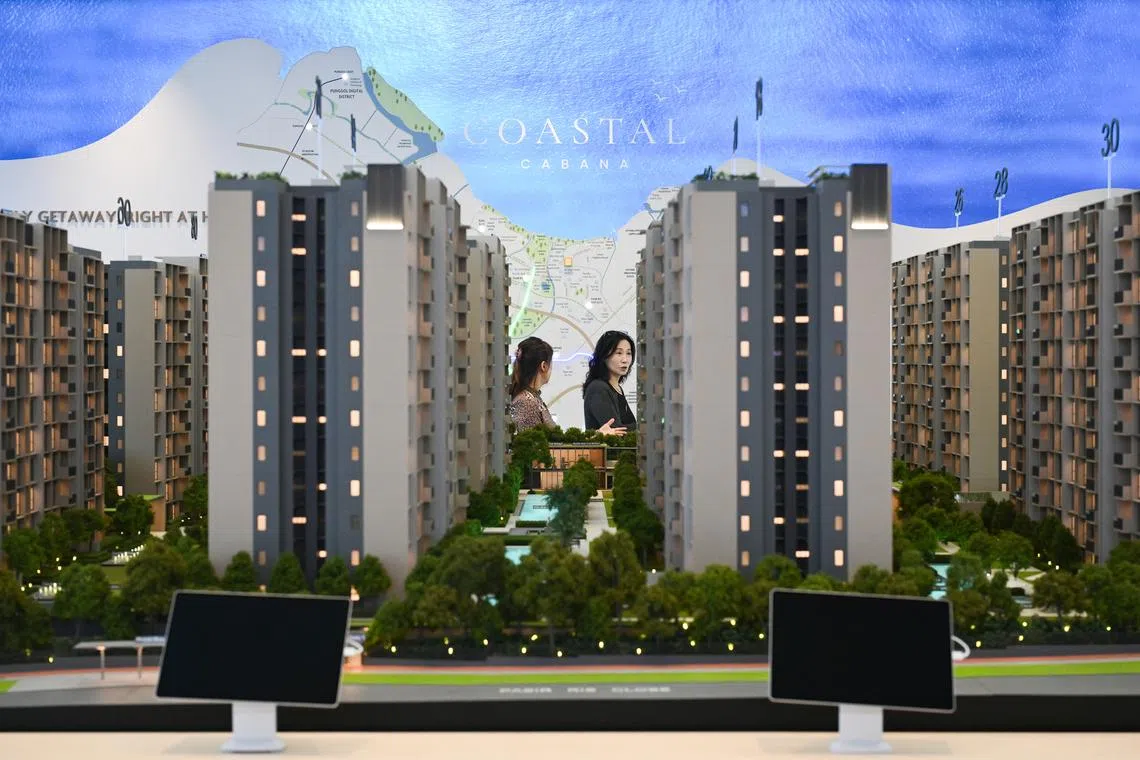
Coastal Cabana, the most recent EC launch, prices its smallest 3-bedroom unit (872 sqft) from S$1.535M. With a household at the S$16,000 income ceiling, the income-capped bank loan of around S$910k forces roughly S$671k of upfront outlay (downpayment plus BSD). The interesting question is what the same S$671k buys you on the private side. Holding the cash entry constant and working backwards, that figure supports a private condo of about S$2.34M before any further tweaks. Here is what that comparison looks like.
| Coastal Cabana EC | Private condo (same cash) | |
|---|---|---|
| Price | S$1.535M | ~S$2.34M |
| Downpayment (cash + CPF) | ~S$625k | ~S$585k (25%) |
| Buyer's Stamp Duty | ~S$46k | ~S$87k |
| ABSD (first-timer citizen) | S$0 | S$0 |
| Total upfront outlay | ~S$671k | ~S$671k |
| Bank loan | ~S$910k (income-capped) | ~S$1.755M (75% LTV) |
| Income cap | S$16,000/month | None |
| Payment schedule | Progressive (was deferred) | Progressive |
| Resale lock-up | 10-year MOP | 4-year SSD |
Same S$671k upfront. The EC at that level of cash gets you a 3-bedder at Coastal Cabana for S$1.535M. On the private side, the same S$671k unlocks roughly S$2.34M of property value, because the bank loan is no longer capped by the EC income ceiling and the buyer can leverage 75% LTV on the full purchase price. That is an extra S$800k of asset value for the same out-of-pocket commitment, which can be redirected toward a better location, a larger unit, or a more reputable development. Both purchases assume first-timer Singapore citizen status, so neither attracts ABSD on the first property.
Why ECs were such a good deal in the first place
The historical case for ECs was not the lifestyle or the location. It was the spread between the launch price (subsidised, restricted) and the open-market resale price five years later (unrestricted, full private status).
According to PropertyLimBrothers' 2025 deep-dive on EC gains, the median profit on EC sales after the 5-year MOP was in the range of S$200,000 to S$500,000. Many cohorts saw gains above that. For a household with a S$625k cash outlay, walking away with a six-figure profit five years later was a uniquely Singaporean financial product. That is what made the EC the most aspired-to housing tier for HDB upgraders.
It is also exactly what the new rules are designed to dampen. If the data shows roughly 75% of ECs were sold on the open market shortly after MOP, then the public-housing rationale for the subsidy was being eroded. Doubling the MOP changes the calculus from a 5-year arbitrage trade into a 10-year occupation commitment.
Source: PropertyLimBrothers, "Should I Sell My EC Upon MOP? Deep Dive into Gains Made by Past EC Owners," April 2025.
Ten years is a long time, and the returns curve says so
The behavioural impact of doubling the MOP is larger than it sounds. Five years is a chapter in a young family's life. Ten years is a generation. School allocations, job mobility, family size, and ageing parents all shift over a decade in ways that they often do not over five.
The financial picture is just as pointed. According to the PropertyLimBrothers EC gains study, the compound annual growth rate on EC holds is highest in the years immediately after MOP and starts tapering noticeably after the 7 to 8 year mark. In other words, the steepest part of the EC return curve sits inside the old 5 to 7 year window. Pushing the resale gate to year 10 forces owners to hold past the period when each additional year of capital appreciation slows down. The very feature that made ECs financially attractive (a sharp post-MOP repricing) has been administratively pushed beyond its peak-return window.
For an investment-minded buyer, the same S$625k cash deployed into the right OCR or RCR condo could plausibly generate equivalent capital gains in 4 to 5 years, with the freedom to sell, rent, or refinance in between. The 10-year EC commitment forecloses those options. For households who genuinely want to occupy the unit for the long haul, the new MOP is irrelevant. For households who treated the EC as a leveraged 5-year property bet with subsidised entry, the trade is materially less attractive.
What this likely does to the condo market
The cohort that historically bought ECs as wealth-building plays does not disappear. It redirects. Households earning above S$12,000 to S$16,000 who would have queued for an EC will now look harder at private resale and new launches in the OCR and RCR. Several second-order effects follow:
- Demand pressure on OCR and RCR new launches. A single EC launch typically clears 600 to 700 households of latent demand. If even a third of that demand pivots to private launches in the same region, it tightens the supply-demand balance for those projects.
- Resale condo prices in OCR and RCR could firm up. Resale 3-bedders priced between S$1.8M and S$2.5M sit directly in the substitution path for would-be EC buyers. As the "EC arbitrage" route closes, more of this segment becomes the default upgrade product.
- The EC buyer profile shifts toward genuine occupiers. First-timer priority and the 10-year MOP filter out short-horizon investors. The remaining EC buyer is closer to the policy archetype: a young family that wants the facilities of a condo at a subsidised price, and is willing to live in it.
- Developer EC bids may compress. If demand at the marginal price point softens, developers will be less aggressive in bidding for EC GLS sites. Whether that ultimately translates to lower launch PSF is a separate question, but the upward bidding pressure of the past few years is unlikely to continue at the same intensity.
Who should still buy an EC
The honest answer: households who actually want to live in an EC for ten years.
If you are a first-timer earning between S$12,000 and S$16,000, want condo facilities, plan to raise children in the unit, and do not view the property primarily as an investment vehicle, an EC is still a strong product. The launch pricing remains below comparable OCR private condos, the build quality is comparable, and the new first-timer priority makes balloting more favourable than before. The math for genuine occupiers has not really changed.
If you are buying because you have heard that ECs are "the smart play," the new rules are telling you something. The smart play has been retired. What is left is a long-term home for families who want one.
The bottom line
The 2026 EC rule changes do not destroy the asset class. They reshape it. The headline numbers (income ceiling, launch PSF, cash outlay) still look familiar. What has changed is the option value embedded in the product. A 5-year MOP with deferred payments was effectively a low-cost long call on the OCR property market. A 10-year MOP with progressive payments is something much closer to ordinary home ownership. The premium has been removed.
For investment-driven households at the income ceiling, the better-risk-adjusted move is increasingly to skip the EC and put the same S$671k of upfront capital into a private condo where the leverage works harder and you keep optionality. For families who simply want a home they can grow into, the EC is still one of the best-value products in Singapore housing, just with more honest expectations attached.
Comparing ECs against private condos in the same region? Bloc lets you filter by district, PSF, and unit type so you can see the substitutes side by side.
Browse condo listings